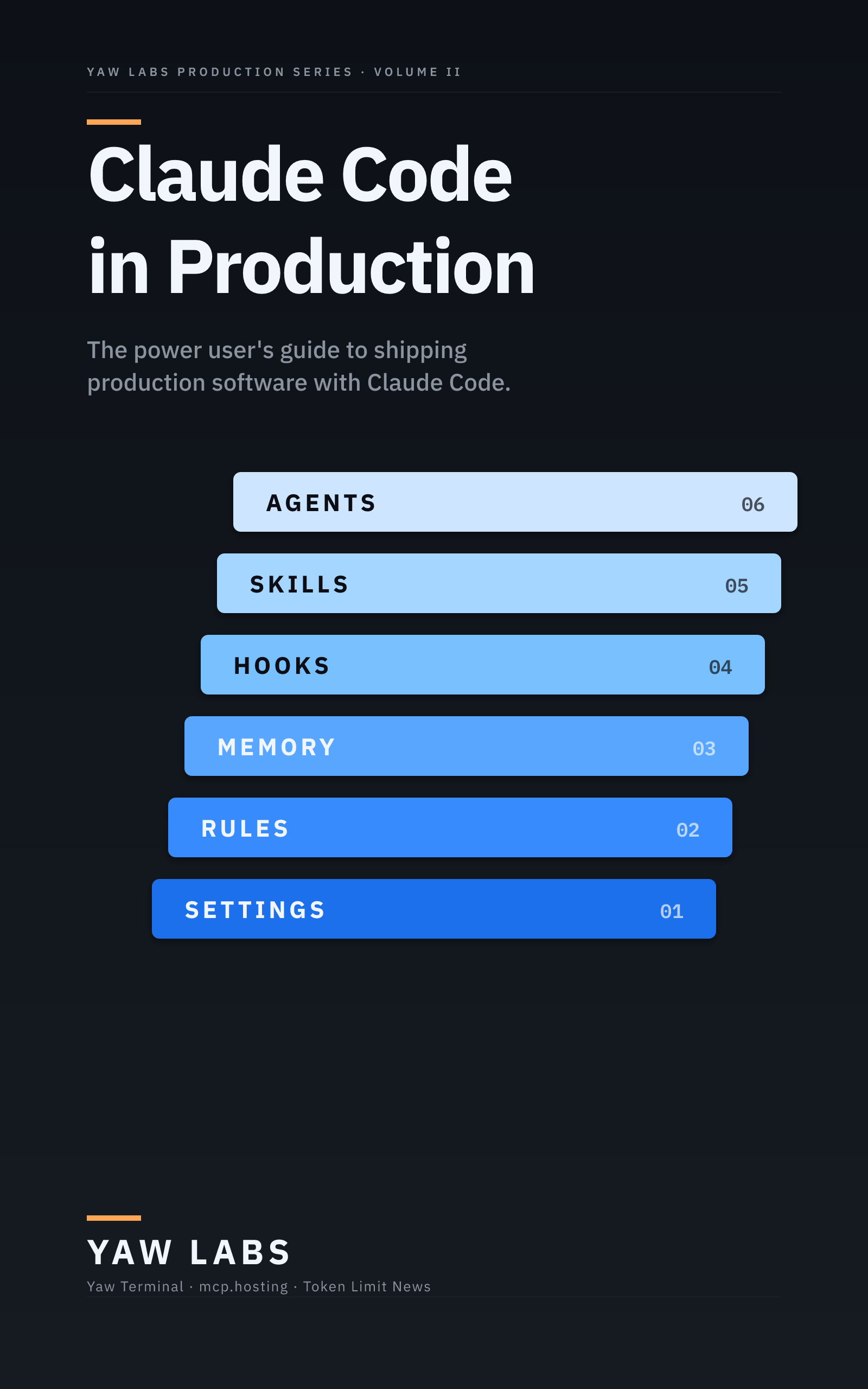
The Anthropic docs cover getting started. This book covers what comes after - when Claude Code has been your daily driver for months, the muscle memory has formed, and the surprises shift from "the model is wrong" to mid-task pivots, hallucinated runtime state, capacity drift, and the "out of scope" punt that becomes next week's blocker.
The fix is not a smarter prompt. The fix is a discipline overlay - a layered set of rules, settings, hooks, skills, memory, and permissions that encodes the failure modes you have actually hit. This book is what shipping daily with Claude Code at Yaw Labs taught us we needed to write down.
PDF + EPUB. Free updates as the surface area moves. Secure checkout via Lemonsqueezy.
What's in the twelve chapters
Part 1 - Foundations
- Chapter 1. The discipline gap - why month six is when the surprise problems show up, and what closing the gap looks like.
- Chapter 2. The CLAUDE.md contract - global vs project, the rule-layering pattern, augment vs fresh, the 600-line file trap.
- Chapter 3. The harness -
settings.json, permission allowlists, hooks. The runtime config most users never open until it costs them.
Part 2 - Workflow
- Chapter 4. Skills and slash commands - the description-as-firing-predicate, when to write one and when to leave it.
- Chapter 5. Subagents and parallelism - the agent menagerie, briefing prompts, trust-but-verify before reporting work as done.
- Chapter 6. Memory persistence across sessions - four memory types, what to save, what NOT to save, staleness and re-verification.
- Chapter 7. Long-running and recurring work -
/loopdynamic mode,/schedule, the prompt-cache cliff and why "300s" is the worst delay.
Part 3 - Reliability
- Chapter 8. Tools and trust boundaries - Bash vs the dedicated tools, and the trust discipline that goes with that.
- Chapter 9. Cost and capacity - model tiers, effort levels, throttle recovery, the recommended-vs-top-tier overthinking trap.
- Chapter 10. Scope discipline and the seven hazards - hallucinated runtime state, branch-protection bypass, terminal mojibake, prompt injection, secret leakage, destructive shortcuts, the "out of scope" punt.
Part 4 - Beyond solo
- Chapter 11. Teams and shared rules - project-scoped settings as a tooling contract, the model-default-floor problem.
- Chapter 12. What's next - MCP integration in brief, autonomous agents, the model-version migration treadmill.
Who it's for
You ship code for a living. You have used Claude Code (or Cursor, or Cline) enough that "tool call" and "subagent" and "permission prompt" are words you use without thinking. You are somewhere between mid and senior on the IC ladder, or you are a tech lead deciding how your team should adopt the tool.
You do not need to be told what a CLAUDE.md is. You need to be told why your CLAUDE.md grew to 600 lines, why nobody on your team is reading it, and what to do about that.
Not for: vendor-neutral tool surveys, prompt-engineering tips, or first-workflow tutorials. The Anthropic docs do those better.
What's in the box
- The book in PDF and EPUB.
- Free updates as the surface area moves - new chapters, updated model references, revisions to the discipline as the field shifts.
- The companion repository at github.com/YawLabs/claude-code-in-production with rule files, skill templates, hook scripts, and annotated
settings.jsonexamples.
Buy Claude Code in Production
Twelve chapters. PDF + EPUB. Free updates. $59 one-time, secured through Lemonsqueezy.
Read the launch post: Claude Code in Production is Out. Companion course coming: Production Claude Code. In the meantime, Yaw Mode ships an opinionated overlay using many of the patterns the book teaches.